 Hawai'i Advocacy
.
.
HAA Truth Sheet – Policy Brief
Evidence-Based Conservation Requires Scientific Predator Attribution Standards
Why Transparent Scientific Wildlife Mortality Investigations Matter for Hawaiʻi Conservation Policy
Executive Summary
The reported mortality of approximately 167–200+ ʻuaʻu kani, or Wedge-tailed Shearwaters, on Kauaʻi is a serious wildlife event deserving careful scientific investigation and public attention. Cats are recognized predators of wildlife and can impact vulnerable island species, especially in sensitive nesting areas. However, established conservation science also emphasizes that wildlife mortality events should be investigated using transparent, evidence-based methods before definitive conclusions are used to shape public opinion, public policy, or animal management decisions.
This principle is not unique to cat management. It reflects broader standards already recognized throughout conservation biology, wildlife forensics, adaptive management, and evidence-based conservation science.
Peer-reviewed literature and conservation guidance consistently emphasize that:
-
conservation decisions should rely on sound evidence,
-
complex ecological systems require multi-factor analysis,
-
uncertainty should be acknowledged openly,
-
interventions should match demonstrated causes,
-
predator presence should not automatically be treated as confirmed predation,
-
and wildlife mortality investigations require proper forensic evaluation.
These principles matter because different causes require different conservation responses. Incorrect attribution can lead to ineffective policy, misdirected resources, public distrust, and failure to address the actual causes of wildlife mortality.
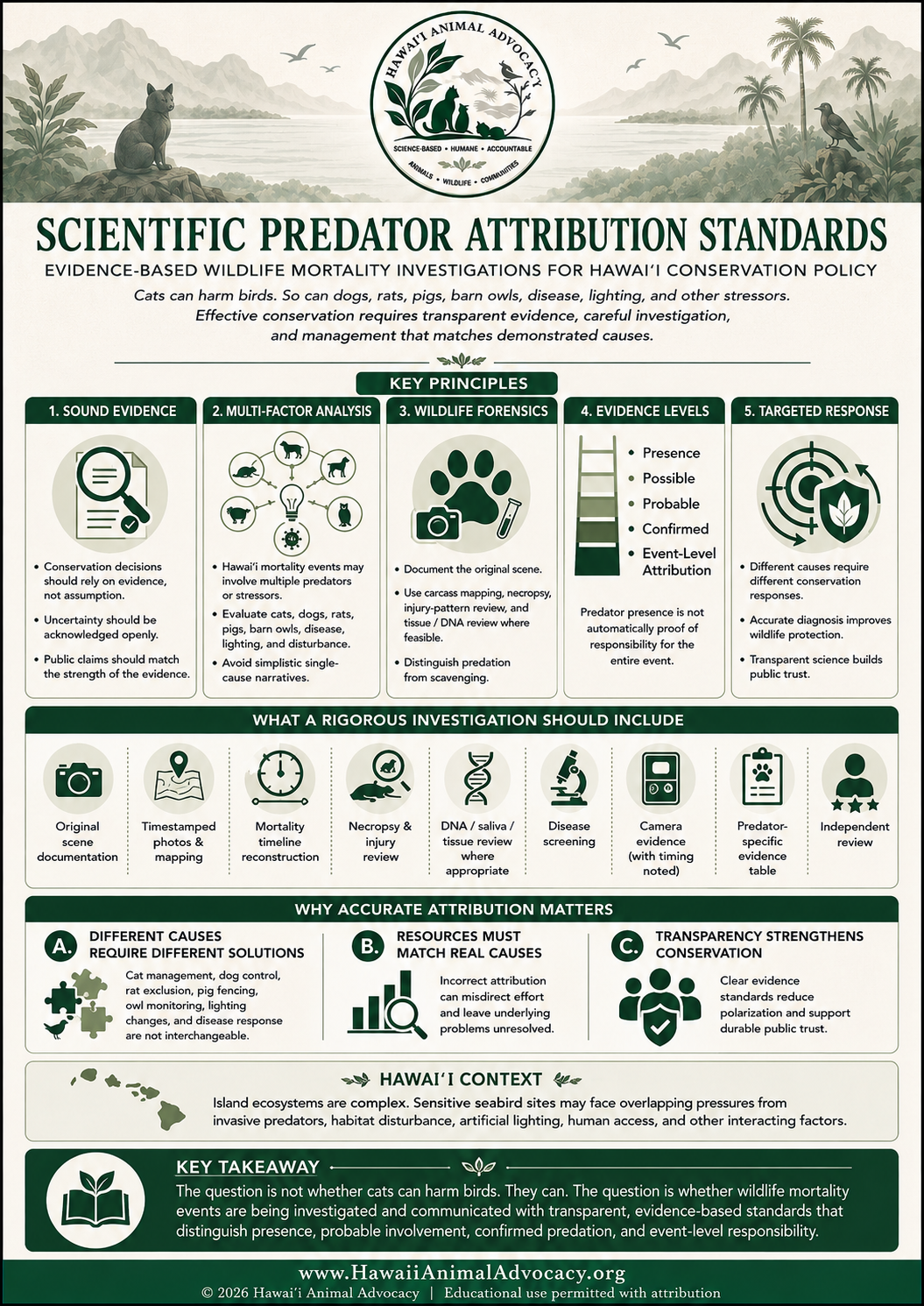
The central issue is not whether cats can harm birds. They can.
The central issue is whether wildlife mortality events that may influence public policy are being investigated and communicated using the same evidence-based standards already widely recognized throughout conservation science and wildlife forensic practice.
This truth sheet reviews:
-
established scientific principles supporting evidence-based conservation,
-
wildlife forensic standards relevant to predator attribution,
-
why multi-factor ecological analysis matters,
-
why evidence categories should distinguish predator presence from confirmed predation,
-
and why accurate diagnosis is essential for effective wildlife protection in Hawaiʻi.
What This Truth Sheet Does Not Dispute
This truth sheet does not dispute that cats can kill birds. It does not dispute that free-roaming cats should be kept out of sensitive wildlife nesting areas. It does not dispute that Hawaiʻi’s seabirds need urgent protection.
The issue is narrower and more scientific: when a wildlife mortality event is used to shape public opinion, public policy, or animal management decisions, predator attribution should be transparent, evidence-based, and appropriately qualified.
Scientific rigor is not obstruction. It is part of effective conservation.
PART 1
Evidence-Based Conservation Requires Scientific Attribution Standards
1. Conservation Science Requires “Sound Evidence”
One of the foundational principles of modern conservation biology is that management decisions should be based on evidence rather than assumption or emotional reaction.
Sutherland et al. 2004
The need for evidence-based conservation
DOI: https://doi.org/10.1017/S0376892904001788
This influential conservation paper helped establish the modern evidence-based conservation movement.
The authors state:
“Conservation practice needs to be based on sound evidence.”
The paper argues that conservation decisions should:
-
rely on rigorous evidence,
-
evaluate uncertainty openly,
-
and avoid assumptions unsupported by data.
Why This Matters
When wildlife mortality events are used to influence legislation, public perception, or conservation policy, conservation science itself supports careful evidence review before definitive conclusions are presented publicly.
2. Ecological Systems Are Complex and Require Multi-Factor Analysis
Conservation science widely recognizes that ecological systems involve multiple interacting variables rather than simple single-cause explanations.
Williams, Szaro & Shapiro 2009
Adaptive Management: The U.S. Department of the Interior Technical Guide
U.S. Department of the Interior
The authors state:
“Adaptive management promotes flexible decision making that can be adjusted in the face of uncertainties.”
This widely cited federal conservation framework explains that:
-
ecological systems are inherently uncertain,
-
management should adapt to evidence,
-
multiple stressors often interact,
-
and assumptions should be tested rather than presumed.
The guide emphasizes:
-
iterative investigation and monitoring,
-
uncertainty acknowledgment,
-
evidence-driven management,
-
and learning from management outcomes.
Why This Matters
In Hawaiʻi, wildlife mortality may involve:
-
cats, dogs, rats, pigs, barn owls, mongooses where present, scavengers, disease, habitat disturbance,
-
artificial lighting, weather, human disturbance, or combined predator scenarios.
Scientific conservation practice supports evaluating the full ecological context before assigning definitive responsibility.
3. Wildlife Forensic Investigation Requires Careful Evidence Collection
Wildlife forensic science emphasizes that predator attribution should rely on documented field evidence rather than assumption alone.
Cooper & Cooper
Wildlife Forensic Investigation: Principles and Practice
CRC Press
Wildlife forensic investigation standards emphasize careful scene documentation, injury analysis, and distinguishing predation from scavenging before definitive conclusions are reached.
Wildlife forensic investigation standards commonly include:
-
scene documentation,
-
carcass mapping,
-
mortality timeline reconstruction,
-
necropsy review,
-
injury pattern analysis,
-
tissue sampling,
-
DNA or saliva analysis where appropriate,
-
chain of evidence,
-
carcass handling documentation,
-
distinguishing predation from scavenging,
-
and cautious interpretation of findings.
Wildlife forensic science recognizes that scavenging after death can complicate interpretation and that predator attribution should ideally rely on direct or strongly supported evidence.
Why This Matters
Large wildlife mortality events should ideally include:
-
forensic documentation,
-
review by qualified wildlife experts,
-
transparent explanation of how conclusions were reached,
-
and evidence categories that distinguish possible, probable, and confirmed predator involvement.
This is especially important when public policy implications may follow.
4. Predator Attribution Requires Evidence Categories
Predator attribution should not be treated as a single yes-or-no claim. Scientific communication should distinguish between different levels of evidence.
|
Evidence Level |
Meaning |
|
Predator presence |
A predator was photographed, tracked, observed, or otherwise documented at or near the site. |
|
Possible predation |
Carcass condition, site evidence, or timing is consistent with a predator hypothesis. |
|
Probable predation |
Multiple evidence types support a predator hypothesis, such as tracks, carcass pattern, timing, and site context. |
|
Confirmed predation |
Direct kill footage, necropsy-supported injury pattern, DNA/saliva evidence, or other strong forensic evidence supports the predator assignment. |
|
Event-level attribution |
Evidence is sufficient to assign responsibility for the mortality event as a whole, including number of animals killed, timing, location, and predator involvement. |
Why This Matters
A predator photographed at a site is evidence of presence. It is not automatically proof of predation.
A carcass pattern may be consistent with a predator. It is not always conclusive by itself.
Camera images taken after carcasses are discovered may support concern, but they are not the same evidentiary category as footage of the kill event itself.
Public communication should clearly distinguish between:
-
cats were present,
-
evidence was consistent with cat predation,
-
cats probably killed some birds,
-
cats were confirmed killing birds,
-
and cats were responsible for the entire mortality event.
These distinctions protect conservation credibility and help ensure that management responses match demonstrated causes.
5. Invasive Predator Science Recognizes Multiple Predator Species
Conservation literature recognizes that island biodiversity loss often involves multiple invasive predator species rather than one single factor or species.
Doherty et al. 2016
Invasive predators and global biodiversity loss
DOI: https://doi.org/10.1073/pnas.1602480113
This widely cited paper identifies invasive predators as major contributors to biodiversity loss globally, especially on islands.
Importantly, the paper discusses:
-
cats,
-
rodents,
-
dogs,
-
pigs,
-
and other invasive mammals.
Why This Matters
The scientific literature supports concern about invasive predators broadly, while also supporting multi-predator analysis rather than automatic single-species attribution.
6. Hawaiʻi Seabird Predation Studies Support Multi-Predator Analysis
Kauaʻi seabird research itself supports the need for multi-predator analysis.
Raine et al. 2020
Managing the Effects of Introduced Predators on Hawaiian Endangered Seabirds
Journal of Wildlife Management, 84:425–435.
DOI: https://doi.org/10.1002/jwmg.21824
In a study of endangered Newell’s shearwaters and Hawaiian petrels on Kauaʻi, Raine et al. reported depredations by multiple introduced predators, including black rats, feral cats, pigs, and barn owls. The study reported 309 depredations between 2011 and 2017, attributed to:
-
black rats,
-
feral cats,
-
pigs,
-
and barn owls.
The study is important because it confirms that cats can be significant predators of vulnerable seabirds, especially adult birds, while also showing that seabird mortality occurs within a broader predator guild.
Why This Matters
Different predators affect seabirds in different ways.
Rats may heavily affect eggs and chicks. Cats may affect adult breeders. Pigs may destroy burrows. Barn owls may take birds at or near colonies. Dogs may kill adults without consuming them.
Effective conservation requires identifying which predators are involved, where they are acting, which life stages are affected, and what management response is appropriate for each threat.
7. Dogs Are Scientifically Recognized Wildlife Predators and Disturbance Agents
Dogs are widely recognized within wildlife science as capable of injuring, stressing, disturbing, or killing wildlife.
Weston & Stankowich 2014
Dogs as agents of disturbance
DOI: https://doi.org/10.1016/j.applanim.2013.12.014
This review explains that wildlife frequently responds to dogs as predators and that dogs can significantly disturb or injure wildlife populations.
Bateman & Fleming 2025
Bad dog? The environmental effects of owned dogs
Pacific Conservation Biology
This review discusses documented wildlife mortality incidents involving dogs, including bird colony mortality events.
Why This Matters
Scientific investigation should evaluate dogs and other predators where evidence supports their possible involvement.
Dogs should not be assumed responsible without evidence. But neither should they be dismissed when a site is accessible to dogs or when carcass condition, puncture wounds, saliva, tracks, or other evidence suggests possible dog involvement.
PART 2
Why Accurate Predator Attribution Matters
1. Different Causes Require Different Conservation Responses
Accurate diagnosis is foundational to effective conservation management.
Different causes may require very different responses:
|
Potential Cause |
Possible Conservation Response |
|
Cats |
Targeted colony management, sterilization, adoption, exclusion, and removal from sensitive nesting zones |
|
Dogs |
Leash enforcement, fencing, stray dog control, owner accountability, access restrictions |
|
Rats or Mongooses |
Predator trapping, exclusion, baiting where appropriate, biosecurity |
|
Pigs |
Fencing, ungulate control, burrow protection, habitat restoration |
|
Barn Owls |
Site-specific predator monitoring and control where legally and ecologically appropriate |
|
Disease |
Surveillance, mosquito control, rehabilitation, health monitoring |
|
Lighting Disorientation |
Lighting restrictions, shielding, seasonal light management |
|
Human Disturbance |
Access management, signage, education, enforcement |
|
Multi-Predator Events |
Integrated management using predator-specific evidence |
Core Principle
Correct diagnosis helps ensure that conservation interventions address the actual causes of harm.
2. Incorrect Attribution Can Produce Ineffective Policy
If wildlife mortality is incorrectly attributed:
-
resources may be directed toward ineffective interventions,
-
underlying causes may remain unresolved,
-
wildlife mortality may continue,
-
public trust may decline,
-
and policy may become reactive rather than evidence-based.
Fuller et al. 2025
Effectiveness of stewardship and management strategies for coastal birds
Avian Conservation and Ecology
This review found that successful coastal bird conservation usually relies on layered and integrated management strategies rather than single-factor approaches.
Why This Matters
Complex conservation problems typically require integrated solutions rather than reactive single-cause narratives.
3. Public Trust Depends on Transparency
Conservation effectiveness depends heavily on public trust and cooperation.
Scientific transparency helps:
-
strengthen credibility,
-
reduce polarization,
-
encourage collaboration,
-
support durable conservation outcomes,
-
and improve compliance with conservation measures.
When evidence standards are unclear or incomplete:
-
public trust may erode,
-
conservation becomes politicized,
-
stakeholder conflict increases,
-
and legitimate wildlife protection efforts may become harder to implement.
Core Principle
Transparent science strengthens conservation legitimacy.
4. Shipwreck Beach Illustrates Why Evidence Standards Matter
The Shipwreck Beach mortality event demonstrates why wildlife mortality claims should be presented with clear evidence categories.
Public reporting states that more than 200 adult ʻuaʻu kani were found dead over a period of several weeks; that carcasses were later gathered together for a photograph; that cameras captured cats at the site after dead birds had already been found; that cat tracks were observed near bird tracks; and that a separate dog-killed ʻuaʻu kani was later identified at the same location.
These facts do not eliminate cats as possible or probable predators. Cats can kill seabirds and should be excluded from sensitive nesting areas. However, the public record also illustrates why predator presence, field-sign interpretation, and post-event camera images should not automatically be treated as conclusive proof of responsibility for an entire mass mortality event.
A scientifically transparent investigation should distinguish between:
-
predator presence,
-
carcass signs consistent with predation,
-
probable predator involvement,
-
confirmed kill evidence,
-
and attribution of the mortality event as a whole.
This distinction protects conservation credibility. It allows agencies and conservation groups to respond quickly while also maintaining scientific accuracy, public trust, and accountability.
5. Post-Event Camera Evidence Should Be Interpreted Carefully
Camera evidence can be extremely valuable in wildlife mortality investigations. However, the evidentiary value depends on timing and content.
A camera image showing a predator present at a site after carcasses are found is evidence of predator presence. It may support concern and justify immediate management action. But it is not the same as direct footage of a predator killing the birds in question.
Scientific communication should clearly distinguish between:
-
direct kill footage,
-
predator presence after the event,
-
predator presence before the event,
-
tracks or sign near carcasses,
-
scavenging behavior,
-
and carcass condition interpreted as consistent with predation.
Core Principle
Camera evidence is important, but its meaning depends on timing, context, and whether it documents presence, scavenging, or the kill event itself.
6. Original Scene Documentation Matters
In wildlife mortality investigations, original scene documentation is especially important.
If carcasses are moved, gathered, staged for communication, or photographed after field collection, that should be clearly disclosed. Moving carcasses may be appropriate for documentation, recovery, public reporting, or disease safety. But once carcasses are moved, the resulting image should not be treated as original scene evidence.
Original scene documentation may include:
-
carcass location mapping,
-
GPS points,
-
field notes,
-
timestamped photographs,
-
carcass condition,
-
distance between carcasses,
-
burrow condition,
-
tracks,
-
predator sign,
-
tissue condition,
-
scavenging evidence,
-
and weather or tide context.
Core Principle
Public photographs can communicate the scale of mortality, but scientific attribution should rely on original scene evidence, not only on images created after carcasses have been gathered or moved.
7. Hawaiʻi’s Ecological Systems Are Especially Complex
Island ecosystems involve:
-
multiple invasive predators,
-
fragile species,
-
disease pressures,
-
habitat fragmentation,
-
watershed degradation,
-
artificial lighting,
-
human access,
-
climate pressures,
-
and intense human interaction.
This complexity means that:
-
multiple factors may interact,
-
mortality events may involve overlapping causes,
-
predators may scavenge carcasses they did not kill,
-
different predators may act at different times,
-
and simplified narratives may fail to identify effective solutions.
Core Principle
Complex ecological systems require careful and evidence-based analysis.
Final Conclusion
The scientific literature clearly supports concern for Hawaiʻi’s seabirds and recognizes that invasive predators can threaten vulnerable island wildlife. Cats can kill birds, and free-roaming cats should not be allowed in sensitive seabird nesting areas.
However, the same conservation science literature also emphasizes that effective wildlife protection depends on rigorous evidence, transparent investigation, acknowledgment of uncertainty, and matching conservation responses to demonstrated causes.
The central issue is not whether cats can harm birds. They can.
The central issue is whether wildlife mortality events that may influence public policy are being investigated and communicated using the same evidence-based standards already widely recognized throughout conservation science and wildlife forensic practice.
Predator attribution should clearly distinguish between:
-
predator presence,
-
possible predation,
-
probable predation,
-
confirmed predation,
-
and event-level responsibility.
This distinction matters because different causes require different responses. A cat problem requires one set of actions. A dog problem requires another. A rat, pig, barn owl, disease, lighting, or human disturbance problem requires different interventions. A multi-predator event requires integrated management.
Effective conservation depends not only on concern for wildlife, but also on accurate diagnosis, scientific transparency, and evidence-based decision-making.
Humane policy and effective conservation both require the same foundation: evidence, accountability, and practical solutions that address the actual causes of harm.
Appendix A
Scientific Standards Recognized in Conservation Science
Modern conservation science recognizes that ecological systems are complex and that management decisions should be guided by transparent evidence, uncertainty acknowledgment, and adaptive learning.
“Conservation practice needs to be based on sound evidence.”
— Sutherland et al., Environmental Conservation (2004)
“Adaptive management promotes flexible decision making that can be adjusted in the face of uncertainties.”
— U.S. Department of the Interior (2009)
“Management actions are treated as experiments from which learning occurs.”
— U.S. Department of the Interior Adaptive Management Technical Guide (2009)
Appendix B
What Would a Scientifically Rigorous Wildlife Mortality Investigation Typically Include?
A scientifically rigorous wildlife mortality investigation would typically include, where feasible:
-
original scene documentation,
-
timestamped photographs,
-
carcass location mapping,
-
GPS points,
-
mortality timeline reconstruction,
-
carcass handling documentation,
-
necropsies,
-
injury pattern analysis,
-
tissue review,
-
DNA or saliva testing where appropriate,
-
disease screening,
-
camera evidence,
-
distinction between direct kill footage and post-event predator presence,
-
predator tracks and sign documentation,
-
burrow condition assessment,
-
scavenging assessment,
-
weather, tide, lighting, and human access context,
-
predator-specific evidence table,
-
independent review where appropriate,
-
and transparent public reporting of confidence levels.
Appendix C
Predator-Specific Evidence Table for Mortality Events
A predator-specific evidence table can help clarify what is known, what is suspected, and what remains uncertain.
|
Predator or Cause |
Evidence to Evaluate |
Possible Management Response |
|
Cats |
Direct footage, tracks, scat, saliva/DNA, carcass tearing, head/neck injury, feather clumps, burrow access |
Exclusion from nesting zones, targeted trapping, adoption, sterilization, managed colony restrictions, removal from sensitive areas |
|
Dogs |
Direct footage, intact carcasses, puncture wounds, saliva, broken neck, tracks, owner/access evidence |
Leash enforcement, fencing, access restrictions, stray dog response, owner accountability |
|
Rats |
Egg/chick predation, burrow camera footage, chew marks, nest failure, rat sign |
Rat control, trapping, baiting where appropriate, exclusion, biosecurity |
|
Pigs |
Dug-up burrows, hoof prints, scat, destroyed habitat, carcass disturbance |
Fencing, ungulate control, burrow protection, habitat restoration |
|
Barn Owls |
Perched carcasses, plucked remains, neck/keel feeding pattern, camera evidence |
Site-specific monitoring and predator control where appropriate |
|
Mongoose |
Tracks, camera footage, carcass removal, regional presence/absence |
Mongoose control where present; exclude where species is absent |
|
Disease |
Necropsy findings, lab testing, outbreak patterns |
Disease surveillance, vector control, rehabilitation |
|
Lighting Disorientation |
Timing, fallout events, night lighting, collision injuries |
Lighting restrictions, shielding, seasonal light management |
|
Human Disturbance |
Foot traffic, off-road vehicles, vandalism, unleashed pets, recreation pressure |
Access management, signage, enforcement, public education |
Appendix D
Recommended Public Communication Standard
When agencies, researchers, conservation organizations, or media outlets report wildlife mortality events, public communication should distinguish evidence from interpretation.
Recommended terms:
|
Term |
Recommended Meaning |
|
Present |
A predator was documented at or near the site. |
|
Consistent with |
Evidence matches a known predator pattern but is not conclusive by itself. |
|
Suspected |
A predator is a plausible cause based on available evidence. |
|
Probable |
Multiple evidence types support the predator assignment. |
|
Confirmed |
Strong forensic evidence, direct footage, necropsy, DNA/saliva, or equivalent evidence supports the assignment. |
|
Event-level attribution |
Evidence supports assigning the mortality event as a whole to a specific predator or cause. |
Recommended Practice
Public statements should avoid presenting probable interpretations as confirmed fact unless the evidence supports that level of certainty.
A responsible statement might say:
“Available field evidence is consistent with cat predation, and cats were documented at the site. Further investigation, including carcass documentation, necropsy review, and predator-specific evidence analysis, would strengthen confidence in event-level attribution.”
References
Bateman, P. W., & Fleming, P. A. (2025). Bad dog? The environmental effects of owned dogs. Pacific Conservation Biology.
Cooper, J. E., & Cooper, M. E. Wildlife Forensic Investigation: Principles and Practice. CRC Press.
Doherty, T. S., Glen, A. S., Nimmo, D. G., Ritchie, E. G., & Dickman, C. R. (2016). Invasive predators and global biodiversity loss. Proceedings of the National Academy of Sciences, 113(40), 11261–11265. https://doi.org/10.1073/pnas.1602480113
Fuller, J. L., et al. (2025). Effectiveness of stewardship and management strategies for coastal birds. Avian Conservation and Ecology.
Honoré, M. (2026). CSI Cats: How Experts ID The Animal Culprits Killing Hawaiʻi’s Seabirds. Honolulu Civil Beat.
Raine, A. F., Driskill, S., Vynne, M., Harvey, D., & Pias, K. (2020). Managing the effects of introduced predators on Hawaiian endangered seabirds. Journal of Wildlife Management, 84, 425–435. https://doi.org/10.1002/jwmg.21824
Sutherland, W. J., Pullin, A. S., Dolman, P. M., & Knight, T. M. (2004). The need for evidence-based conservation. Environmental Conservation, 31(1), 6–7. https://doi.org/10.1017/S0376892904001788
Weston, M. A., & Stankowich, T. (2014). Dogs as agents of disturbance. Applied Animal Behaviour Science, 152, 1–12. https://doi.org/10.1016/j.applanim.2013.12.014
Williams, B. K., Szaro, R. C., & Shapiro, C. D. (2009). Adaptive Management: The U.S. Department of the Interior Technical Guide. Adaptive Management Working Group, U.S. Department of the Interior.
About the Author
Greg Puʻuwai Aloha Baker holds an MBA and a Certificate in Community Cat Program Management from the University of the Pacific’s Benerd College.
The University of the Pacific certificate program is an intensive eight-week professional course designed to equip animal welfare professionals, nonprofit leaders, veterinary students, animal control personnel, and community advocates with practical skills for managing community cat populations through humane, evidence-based strategies. The program covers Trap-Neuter-Return, public engagement, legal and policy considerations, funding models, and long-term program sustainability.
Greg has been actively involved in community cat management, rescue, and advocacy on Hawaiʻi Island for more than five years. He has personally participated in the trapping, sterilization, and return of more than 100 community cats and regularly volunteers at high-volume PetFix Spay/Neuter MASH events serving both cats and dogs.
His work increasingly focuses on the intersection of humane animal management, conservation policy, public health, and community stewardship. In response to Hawaiʻi County Bill 51, the proposed cat feeding ban, Greg organized public education and advocacy efforts that contributed to more than 7,600 petition signatures in opposition to the measure and helped mobilize widespread community testimony supporting science-based and humane alternatives.
These efforts ultimately led to the founding of Hawaiʻi Animal Advocacy, a Hawaiʻi-based organization advancing evidence-based, humane approaches to animal population management and public policy.
Greg’s policy and educational work emphasizes measurable outcomes, scientific accountability, humane population stabilization, and practical coexistence strategies that support both animal welfare and long-term ecological health.
About Hawaiʻi Animal Advocacy
Hawaiʻi Animal Advocacy is a Hawaiʻi-based organization dedicated to advancing science-based, humane policy for animal population management.
HAA works at the intersection of animal welfare, conservation, public health, and community stewardship. The organization promotes evidence-based strategies that address the root causes of free-roaming animal populations while supporting the protection of native wildlife, ecosystem health, and community well-being.
HAA recognizes that conservation challenges in Hawaiʻi are complex and multifactorial, involving habitat loss, invasive species, disease, watershed degradation, climate pressures, and human activity. Effective solutions therefore require integrated, measurable, and publicly accountable approaches rather than single-factor responses.
The organization supports humane population stabilization through targeted sterilization programs, responsible colony management, adoption pathways, public education, and collaborative community engagement. HAA also advocates for improved scientific rigor, transparent policymaking, and management strategies grounded in verifiable evidence and real-world outcomes.
Underlying HAA’s work is a core principle: “Humane policy is effective policy.”
By combining science, stewardship, and Aloha ʻĀina, HAA seeks practical solutions that reduce suffering, strengthen conservation outcomes, and foster long-term coexistence between communities, animals, and Hawaiʻi’s environment.
© 2026 Hawaiʻi Animal Advocacy. Educational use permitted with attribution.