 Hawai'i Advocacy
Understanding Ecological Fragility, Low Resilience, and the Complexity of Hawaiian Bird Extinction
TRUTH SHEET - Scientific Brief – Ecological Resilience and Hawaiian Bird Decline
Author: Greg Pu’uwai Aloha Baker
www.HawaiiAnimalAdovcacy.org
Introduction
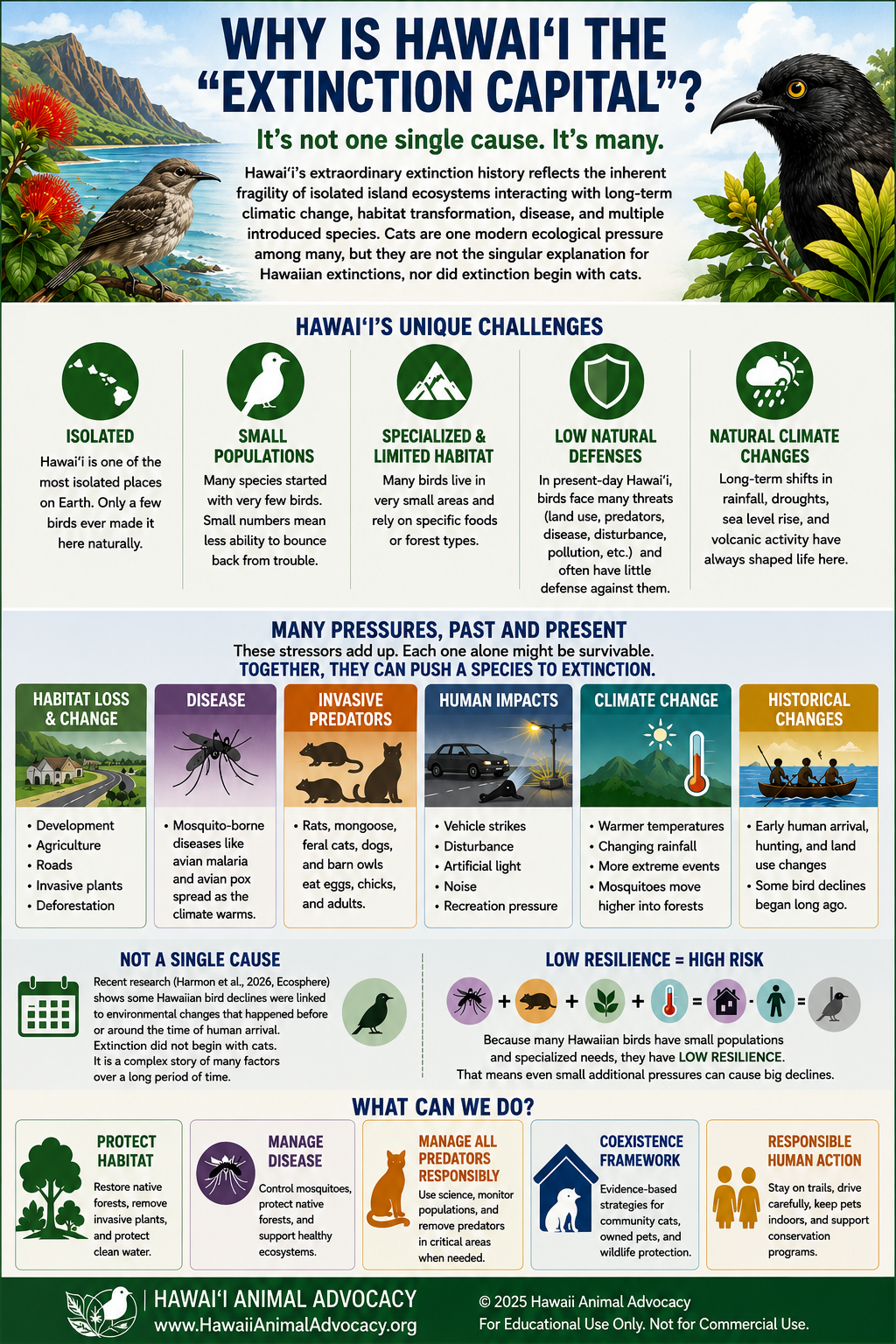
Hawaiʻi is often called the “extinction capital of the world” because the Hawaiian Islands have experienced an unusually high number of bird extinctions compared to most places on Earth. However, public discussion often oversimplifies why this happened.
The scientific evidence increasingly suggests that Hawaiian extinctions cannot honestly be explained by a single cause or a single species. Instead, Hawaiʻi’s extraordinary extinction history reflects the inherent fragility of isolated island ecosystems interacting with long-term climate change, habitat transformation, disease, and multiple introduced species. Cats are one modern ecological pressure among many, but they are not the singular explanation for Hawaiian extinctions, nor did extinction begin with cats.
Many Hawaiian bird species evolved in one of the most isolated ecosystems on Earth. These species often developed:
- Very small population sizes,
- Narrow habitat specialization,
- Low reproductive capacity,
- Limited predator defenses,
- Little evolutionary exposure to mammalian predators.
As a result, many Hawaiian birds have relatively low ecological resilience — meaning they have limited ability to absorb rapid environmental change without population collapse.
Today, Hawaiian birds face multiple overlapping pressures simultaneously:
- Habitat loss and fragmentation,
- Climate change,
- Mosquito-borne diseases such as avian malaria,
- Invasive plants and ecosystem alteration,
- Human development and roads,
- Artificial lighting impacts,
- Rats, mongoose, dogs, cats, pigs, owls, and hawks,
- Long-term ecological disruption from introduced species.
This “multiple stressor” environment helps explain why extinction vulnerability in Hawaiʻi is so high.
Understanding this broader ecological reality is important because simplistic narratives focused on a single predator can distort conservation priorities and public understanding.
Effective conservation in Hawaiʻi requires comprehensive ecosystem management, evidence-based predator control, habitat protection, disease mitigation, and responsible management of human-associated animal populations.
Hawaiʻi Is One of the Most Isolated Ecosystems on Earth
The Hawaiian Islands formed thousands of miles from major continental land masses. Over millions of years, only a very small number of birds successfully colonized the islands.
These rare colonization events produced extraordinary evolutionary diversity. A small founder population could evolve into many unique Hawaiian species found nowhere else on Earth. However, this evolutionary isolation also created vulnerability.
Many Hawaiian birds evolved:
- Without mammalian predators,
- In highly stable ecological conditions,
- In restricted geographic areas,
- With relatively small total populations.
This means many species lacked strong evolutionary defenses against rapid environmental disruption.
Ecological Fragility and “Low Resilience”
One of the most important concepts for understanding Hawaiian extinction risk is ecological resilience.
Resilience refers to: the ability of a species or ecosystem to absorb disturbance without collapsing.
Many Hawaiian bird species appear to have relatively low resilience because they evolved in isolated ecosystems with:
- Small populations,
- Specialized ecological roles,
- Limited reproductive redundancy,
- Restricted habitat ranges.
A continental bird species with millions of individuals across broad landscapes may be able to survive substantial environmental disruption. In contrast, a Hawaiian bird species with only a few thousand individuals — or a few hundred breeding pairs — may face severe extinction risk from relatively modest additional pressures.
This helps explain why Hawaiian ecosystems are particularly vulnerable to ecological change.
Extinction in Hawaiʻi Did Not Begin With Cats
Modern public discussion sometimes creates the impression that Hawaiian extinctions began primarily because of cats. The scientific evidence does not support such a simplified explanation.
Recent scholarship, including discussions emerging from research published in Ethos, suggests that multiple Hawaiian bird extinctions likely occurred before Polynesians - “Kanaka Maoli” arrival influenced by long-term environmental and climatic changes in the islands.
Researchers increasingly recognize the importance and resulting impact of:
- Sea-level fluctuations,
- Changes in rainfall and precipitation,
- Habitat transitions,
- Volcanic and landscape changes,
- Long-term climatic instability,
- Ecological turnover over thousands of years.
This does not mean human activity had no impact. Human land transformation, hunting, introduced species, and ecosystem alteration clearly contributed to significant ecological change over time. However, it does mean Hawaiian extinction history is much more complex than a single-cause narrative.
.
Hawaiian Birds Face “Stacked Pressures”
One of the clearest ways to understand modern Hawaiian bird decline is through the
concept of cumulative ecological stress. Today, many Hawaiian bird populations face multiple pressures simultaneously such as:
Disease
Mosquito-borne diseases such as avian malaria and avian pox are considered among the most severe threats to many native forest birds. Climate warming is allowing mosquitoes to move into higher elevation forests that historically served as disease refuges.
Habitat Loss and Fragmentation
Urbanization, agriculture, invasive plants, road systems, and development reduce and fragment habitat needed by native species.
Introduced Predator Guild
Hawaiian birds now interact with multiple introduced predators including:
- Rats (responsible for about 76% of predation in forest areas),
- Mongoose (responsible for about 75% of predation in lowland/marshland areas),
- Dogs,
- Cats,
- Pigs,
- Barn owls and other predators in some environments.
Different predators affect birds differently:
- Rats often prey on eggs and chicks,
- Mongoose often prey on eggs, chicks, and mature birds,
- Dogs can cause mass mortality colony disturbances,
- Cats may prey on fledglings or weakened birds,
- Disease can increase vulnerability to predation generally.
Human Activity
Vehicle strikes, artificial lighting, noise, recreation pressure, and expanding development all negatively affect wildlife survival and breeding success.
Why Simplistic Narratives Can Be Misleading
Because Hawaiian bird populations are often already operating near ecological limits, assigning extinction risk to a single factor can be misleading.
The reality is that many species face: multiple simultaneous pressures in a low resilience ecosystem.
This broader systems perspective is important because conservation resources are limited. And oversimplified narratives may unintentionally divert attention from:
- Disease management,
- Habitat restoration,
- Mosquito control,
- Watershed protection,
- Climate adaptation,
- Responsible pet ownership,
- Management of all introduced predator pressures.
Scientific conservation planning increasingly recognizes that successful protection of Hawaiian wildlife requires integrated ecosystem management plans, rather than single-factor explanations.
.
The Role of Cats in the Broader Ecological System
Cats can impact wildlife, particularly in sensitive habitats or unmanaged situations near vulnerable bird populations. Responsible management is therefore important.
However, the scientific evidence does not support the claim that cats alone explain Hawaiian bird extinction history.
Cats are:
- One ecological pressure among many,
- Not primary driver of extinction nor primary predator usually,
- Part of a broader predator guild,
- One factor operating within already fragile ecosystems.
This distinction matters because effective conservation requires reducing overall ecological pressure rather than focusing exclusively on one species.
A Coexistence-Based Ecological Framework Is Needed
This requires a Conservation Science-Based management model for Community Cats, Wildlife Protection, and Human Communities. A framework for managing cat populations that recognizes different environments require different management strategies to stabilize and decrease their numbers. The framework is not based on the assumption that all cats should remain everywhere, nor does it reject conservation science or wildlife vulnerability. Instead, it applies established principles from:
- Adaptive Management,
- Conservation Biology,
- Systems Ecology,
- Risk-based Prioritization,
- Landscape Ecology,
- and Outcome-Based Conservation Science.
The framework recognizes that:
- ecological risks vary by habitat,
- not all landscapes have equal wildlife sensitivity,
- prevention and stabilization are often more effective than reactive approaches alone,
- and conservation success should be measured through ecological outcomes rather than simplistic numerical targets.
.
Wildlife Conservation Zones
Sensitive nesting habitat or critically endangered species areas may require aggressive predator management and restricted human disturbance.
.
Community Cat Management Zones
Human-dominated environments can benefit from:
-
High-intensity (min. 75% fix rate) Trap-Neuter-Return (TNR),
-
Managed feeding protocols,
-
Adoption pathways,
-
Population stabilization,
-
Reduced roaming and nuisance behaviors.
.
Pet Cat Zones
Indoor living, sterilization, abandonment prevention, and responsible ownership reduce ecological impacts while improving cat welfare.
This type of adaptive management framework reflects systems ecology rather than simplistic “one cause” narratives.
.
Conclusion
Hawaiʻi’s extinction history is best understood as the result of ecological fragility interacting with long-term environmental change and multiple overlapping stressors.
Many Hawaiian bird species evolved in entirely isolated ecosystems with inherently low resilience to disturbance. As climate change, disease, habitat transformation, and introduced predators accumulated over time, extinction risk increased dramatically.
Cats are one modern ecological pressure within this larger system, but they are not the singular explanation for Hawaiian extinctions, nor did extinction begin with cats.
Protecting Hawaiian wildlife therefore requires a comprehensive coexistence approach grounded in:
- Ecological Science,
- Adaptive Management,
- Habitat protection,
- Disease mitigation,
- Responsible human behavior,
- And evidence-based reduction of all major ecological pressures.
Effective conservation depends not on simplistic blame narratives, but on understanding the full complexity of Hawaiʻi’s uniquely fragile ecosystems.
Selected Scientific and Historical References
- Harmon, K., et al. (2026). Study examining Hawaiian waterbird extinction dynamics, environmental change, and Indigenous impacts in pre-contact Hawaiʻi. Ecosphere. University of Hawaiʻi at Mānoa.
- Van Riper, C., & Scott, J. M. (2001). Limiting Factors Affecting Hawaiian Native Birds. Studies in Avian Biology, 22, 221–233.
- Doherty, T. S., Glen, A. S., Nimmo, D. G., Ritchie, E. G., & Dickman, C. R. (2016). Invasive predators and global biodiversity loss. Proceedings of the National Academy of Sciences, 113(40), 11261–11265.
- Woinarski, J. C. Z., Murphy, B. P., Legge, S. M., et al. (2017). How many birds are killed by cats in Australia? Biological Conservation, 214, 76–87.
- Lynn, W. S., Santiago-Ávila, F., Lindenmayer, J., et al. (2019). A moral panic over cats. Conservation Biology, 33(4), 769–776.
- Van Wormer, E., Fritz, H., Shapiro, K., et al. (2013). Coastal development and precipitation drive pathogen pollution of nearshore waters. EcoHealth, 10, 277–289.
About the Author
Greg Puʻuwai Aloha Baker holds an MBA and a Certificate in Community Cat Program Management from the University of the Pacific’s Benerd College.
The University of the Pacific certificate program is an intensive eight-week professional course designed to equip animal welfare professionals, nonprofit leaders, veterinary students, animal control personnel, and community advocates with practical skills for managing community cat populations through humane, evidence-based strategies. The program covers Trap-Neuter-Return (TNR), public engagement, legal and policy considerations, funding models, and long-term program sustainability.
The course was developed and taught by nationally recognized community cat expert Stacey LeBaron, founder of Community Cats Podcast and former leader of the Newburyport, Massachusetts waterfront TNR initiative, widely recognized as one of the earliest documented large-scale targeted TNR success stories in the United States.
Greg has been actively involved in community cat management, rescue, and advocacy on Hawaiʻi Island for more than five years. He has personally participated in the trapping, sterilization, and return of more than 100 community cats and regularly volunteers at high-volume PetFix Spay/Neuter MASH events serving both cats and dogs.
His work increasingly focuses on the intersection of humane animal management, conservation policy, public health, and community stewardship. In response to Hawaiʻi County Bill 51, the proposed cat feeding ban, Greg organized public education and advocacy efforts that contributed to more than 7,600 petition signatures in opposition to the measure and helped mobilize widespread community testimony supporting science-based and humane alternatives.
These efforts ultimately led to the founding of Hawaiʻi Animal Advocacy (HAA), a Hawaiʻi-based organization advancing evidence-based, humane approaches to animal population management and public policy.
Greg’s policy and educational work emphasizes measurable outcomes, scientific accountability, humane population stabilization, and practical coexistence strategies that support both animal welfare and long-term ecological health.
About Hawaiʻi Animal Advocacy
Hawaiʻi Animal Advocacy (HAA) is a Hawaiʻi-based organization dedicated to advancing science-based, humane policy for animal population management.
HAA works at the intersection of animal welfare, conservation, public health, and community stewardship. The organization promotes evidence-based strategies that address the root causes of free-roaming animal populations while supporting the protection of native wildlife, ecosystem health, and community well-being.
HAA recognizes that conservation challenges in Hawaiʻi are complex and multifactorial, involving habitat loss, invasive species, disease, watershed degradation, climate pressures, and human activity. Effective solutions therefore require integrated, measurable, and publicly accountable approaches rather than single-factor responses.
The organization supports humane population stabilization through targeted sterilization programs, responsible colony management, adoption pathways, public education, and collaborative community engagement. HAA also advocates for improved scientific rigor, transparent policymaking, and management strategies grounded in verifiable evidence and real-world outcomes.
Underlying HAA’s work is a core principle: “Humane policy is effective policy”.
By combining science, stewardship, and Aloha ʻāina, HAA seeks practical solutions that reduce suffering, strengthen conservation outcomes, and foster long-term coexistence between communities, animals, and Hawaiʻi’s environment.
© 2026 Hawaiʻi Animal Advocacy (HAA). Educational use permitted with attribution.