 Hawai'i Advocacy
.
.
HAA One Health Alignment Standard™
A Policy Evaluation Standard for Humane, Science-Based Cat Population Management in Hawaiʻi
Prepared by: Greg Puʻuwai Aloha Baker, Founder
Organization: Hawaiʻi Animal Advocacy
Draft Version: 1.0
Date: June 2026
Purpose and Scope
The HAA One Health Alignment Standard evaluates whether a cat population policy, program, ordinance, agency action, or public claim is aligned with a One Health approach. For purposes of this standard, One Health alignment requires that policy decisions consider the connected health of people, domestic animals, wildlife, ecosystems, and communities rather than treating any one domain in isolation.
This standard is designed for use in reviewing community cat management proposals, public agency actions, shelter policies, conservation claims, feeding restrictions, trap-neuter-return programs, wildlife-zone interventions, and related public-health or animal-welfare policies. It is not intended to replace legal review, veterinary judgment, conservation biology, public-health practice, or agency-specific regulatory authority. Its purpose is to provide a structured method for determining whether a proposed action reflects integrated, evidence-informed, humane, and accountable management.
A policy may address one legitimate concern and still fail One Health alignment if it produces foreseeable harm in another part of the system. A policy that reduces visible cats while increasing abandonment, unmanaged reproduction, disease risk, shelter burden, public conflict, or ecological displacement has not improved the whole system. Similarly, a cat welfare program that fails to address endangered species, sensitive habitats, or measurable wildlife risk does not satisfy One Health expectations.
Definition of One Health
One Health is widely defined as an integrated approach that seeks to balance and optimize the health of people, animals, and ecosystems. It recognizes that the health of humans, domestic and wild animals, plants, and the wider environment is closely linked and interdependent.
For Hawaiʻi cat population management, this definition has direct policy relevance. Free-roaming cat populations are not only an animal-welfare issue, a conservation issue, a public-health issue, or a community-conflict issue. They are a systems issue created and sustained by human behavior, reproduction, abandonment, land use, shelter capacity, veterinary access, food availability, wildlife vulnerability, and public policy. A One Health approach therefore requires coordinated action across animal welfare, public health, conservation, local government, veterinary services, shelters, caretakers, property owners, and affected communities.
Relationship to the HAA Coexistence Framework
The HAA Coexistence Framework is the operating model for humane and accountable cat population management in Hawaiʻi. It organizes management around three primary zones: the Pet Zone, the Community Zone, and the Wildlife Zone. Each zone requires different interventions because risk, responsibility, and ecological context differ by place.
The One Health Alignment Standard evaluates whether a policy or program is consistent with that operating model. It does not replace the Coexistence Framework. Instead, it provides an evaluation method for determining whether a proposed action has the governance, prevention, public-health, animal-welfare, data, response, workforce, and community-capacity components needed to improve the whole system.
A policy aligned with the Coexistence Framework should reduce the source population of cats, prevent abandonment, support humane management, protect native wildlife, reduce public-health risk, strengthen public accountability, and measure outcomes over time. These requirements are consistent with a One Health approach because they address the connected causes and consequences of free-roaming cat populations rather than relying on a single intervention or single metric.
Relationship to the Conservation Science Compliance Standard
The Conservation Science Compliance Standard remains a separate scientific review standard. It is not a One Health scoring domain and is not converted into a One Health score. It evaluates whether wildlife, ecosystem, predator-risk, sensitive-habitat, extinction-risk, or conservation-outcome claims meet minimum conservation science requirements.
Where a policy, program, ordinance, agency action, or public claim involves wildlife protection, sensitive habitats, ecosystem effects, predator impacts, extinction risk, or conservation outcomes, the Conservation Science Compliance Standard must be applied separately. The resulting scientific compliance score shall be reported alongside the One Health Alignment score.
A final determination of Strong One Health Alignment or Model One Health Alignment requires the applicable minimum result under the Conservation Science Compliance Standard. If the scientific compliance result is below the required threshold, the final One Health determination shall be capped even if the One Health implementation score is otherwise high. This approach preserves the independent value of conservation science while recognizing that One Health alignment cannot be complete when conservation claims are unsupported, incomplete, or inconsistent with ecological evidence.
Core Evaluation Principle
The central question under this standard is whether the policy improves the whole connected system. A One Health-aligned policy should reduce unmanaged cat populations, improve animal welfare, protect human health, reduce community conflict, protect native wildlife, account for ecological context, and create measurable accountability.
A policy is not One Health-aligned merely because it invokes public health, animal welfare, or conservation as a purpose. The relevant question is whether the policy is designed and implemented in a manner that can reasonably be expected to improve outcomes across the connected system. Policies that shift harm from one domain to another do not satisfy this standard.
Evaluation Domains
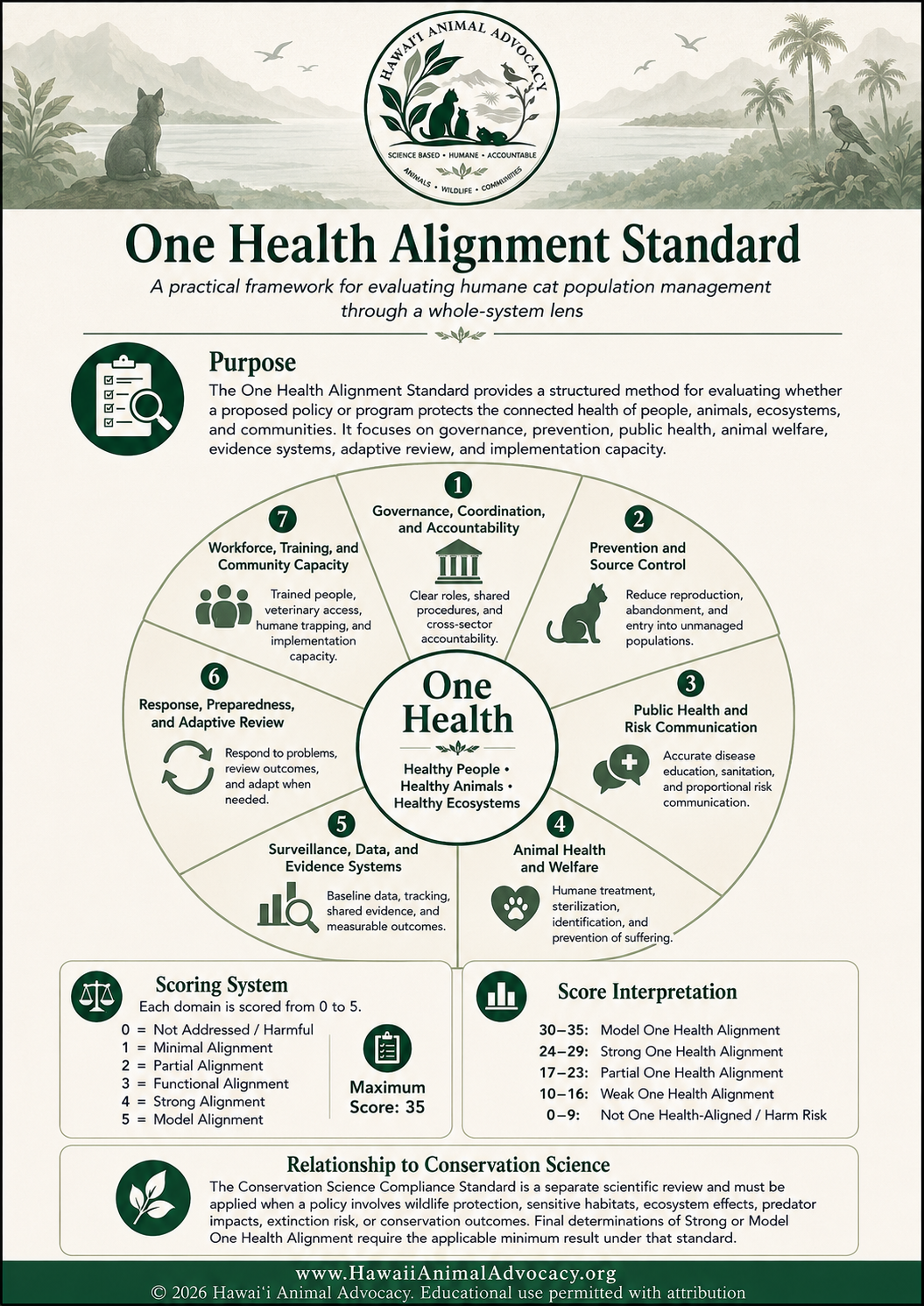
The One Health Alignment Standard uses seven implementation domains. Each domain evaluates a distinct component of One Health practice. The domains are designed to be specific enough to support scoring while broad enough to apply across ordinances, programs, agency actions, and public claims.
1. Governance, Coordination, and Accountability
This domain evaluates whether the policy establishes the coordination and accountability required for One Health implementation. Cat population management involves multiple sectors, including animal services, shelters, veterinarians, public-health agencies, conservation managers, landowners, caretakers, community organizations, and local government. A policy that does not define the role of these actors is unlikely to produce stable outcomes.
A strong policy identifies responsible parties, establishes clear procedures, defines decision authority, creates coordination between sectors, and provides a mechanism for resolving conflicts. It should clarify how animal-welfare concerns, public-health concerns, conservation concerns, and community complaints are handled. It should also identify who is responsible for implementation, funding, data collection, enforcement, review, and corrective action.
Weak alignment is indicated when a policy assigns responsibility broadly but does not identify who will act, how decisions will be made, how conflicts will be resolved, or how outcomes will be reviewed. A policy that relies on voluntary cooperation without operational structure may be insufficient, particularly where wildlife risk, public controversy, or large unmanaged populations are present.
2. Prevention and Source Control
This domain evaluates whether the policy addresses the sources that create and sustain unmanaged cat populations. One Health implementation generally favors prevention over crisis response. In cat population management, prevention requires reducing reproduction, preventing abandonment, identifying cats, and limiting the movement of cats from owned or semi-owned settings into unmanaged community populations.
A strong policy includes pet sterilization, accessible spay-neuter services, microchipping or other identification, abandonment prevention, kitten prevention, targeted high-intensity trap-neuter-return where appropriate, vaccination where feasible, and adoption pathways for kittens and socialized cats. It should address intact owned cats, informal feeding without sterilization, dumping, and other source pathways that contribute to population growth.
Weak alignment is indicated when a policy focuses on visible cats without reducing the source population. Removal, feeding restriction, or enforcement activity may reduce visibility in the short term while leaving reproduction, abandonment, and replacement dynamics unchanged. A policy that does not reduce births or prevent new cats from entering the unmanaged population cannot be considered a strong prevention strategy.
3. Public Health and Risk Communication
This domain evaluates whether public-health concerns are addressed accurately, proportionately, and constructively. Cat population policy may involve legitimate public-health issues, including sanitation, nuisance, bites or scratches, parasites, and zoonotic disease concerns such as toxoplasmosis. These issues require accurate education and practical prevention rather than fear-based claims or generalized blame.
A strong policy distinguishes between real risk pathways and exaggerated public perception. It should improve sanitation, reduce unmanaged feeding conditions, support vaccination where appropriate, provide disease-risk education, and explain how sterilization, kitten prevention, and managed colonies can reduce relevant risks over time. Public communication should be clear, evidence-informed, and proportional to documented risk.
Weak alignment is indicated when public-health language is used primarily to justify punitive action without addressing prevention, sanitation, source control, or accurate education. Fear-based messaging can damage public trust, increase conflict, stigmatize caretakers, and distract from interventions that reduce actual risk.
4. Animal Health and Welfare
This domain evaluates whether the policy protects the health and welfare of cats while reducing unmanaged populations. Cats are domestic animals and sentient beings. Their management should therefore include humane treatment, veterinary access where feasible, sterilization, identification, adoption pathways, and safeguards against starvation, cruelty, abandonment, and unmanaged suffering.
A strong policy supports sterilization, vaccination where appropriate, ear-tipping or microchip identification, responsible feeding standards, shelter diversion where appropriate, adoption of kittens and socialized cats, humane trapping, and humane removal from locations where cats cannot safely remain. It should distinguish managed colonies from unmanaged dumping and should recognize that responsible caretakers can serve as accountable non-owner stewards when properly trained and monitored.
Weak alignment is indicated when a policy creates foreseeable animal suffering without mitigation. Feeding bans, unmanaged removals, or enforcement policies that cause starvation, dispersal, abandonment, or unnecessary shelter killing may fail this domain even if they are presented as public-health or conservation measures. Humane treatment is not optional under a One Health approach; it is one of the health domains being evaluated.
5. Surveillance, Data, and Evidence Systems
This domain evaluates whether the policy creates the evidence systems needed to understand conditions, track interventions, and measure outcomes. One Health implementation depends on shared information across sectors. Cat population management cannot be evaluated reliably without baseline data, intervention tracking, and outcome measurement.
A strong policy collects baseline information on cat populations, sterilization status, feeding locations, caretaker participation, shelter intake, complaint patterns, abandonment reports, wildlife conflict, and relevant public-health concerns. It should track interventions over time and allow data to be reviewed by the responsible parties. Where feasible, colony software, microchip data, veterinary records, shelter data, complaint records, and conservation observations should be used to support a shared evidence picture.
Weak alignment is indicated when a policy is adopted without baseline data, measurable targets, or reporting requirements. Activity measures, such as the number of cats trapped or citations issued, are not sufficient by themselves. The relevant question is whether the policy changes population, welfare, public-health, community, and conservation outcomes.
6. Response, Preparedness, and Adaptive Review
This domain evaluates whether the policy can respond to changing conditions and adjust when evidence shows failure. One Health implementation requires more than an initial plan. It requires response capacity, preparedness for foreseeable disruptions, and review mechanisms that allow management to change based on results.
A strong policy includes procedures for complaint response, disease concern response, abandonment surges, emergency feeding disruptions, colony transition, shelter capacity limits, wildlife-zone escalation, and coordination with conservation managers when risk changes. It should include scheduled review and a clear process for revising actions when outcomes do not meet expectations.
Weak alignment is indicated when a policy assumes that a single action will solve a complex system problem. Cat populations, public behavior, wildlife risk, shelter capacity, and community conflict change over time. A policy without adaptive review may continue even when it is ineffective or harmful.
7. Workforce, Training, and Community Capacity
This domain evaluates whether the policy has the trained people and practical capacity needed for implementation. One Health depends on multisectoral participation, but coordination alone is not sufficient. The system must have adequate human capacity, technical capacity, and community capacity to carry out the work.
A strong policy supports trained caretakers, humane trappers, veterinary capacity, shelter pathways, data-entry capacity, public education, conservation coordination, and community participation. It should recognize that unmanaged cat populations cannot be reduced through policy language alone. Implementation requires people who can trap, transport, sterilize, vaccinate, identify, feed responsibly, monitor colonies, respond to complaints, record data, place adoptable animals, and coordinate with land managers.
Weak alignment is indicated when a policy imposes requirements without creating the capacity needed to meet them. A rule that requires sterilization without veterinary access, prohibits feeding without transition support, or demands removal without shelter or placement capacity may produce noncompliance, abandonment, or unmanaged suffering.
Scoring Method
Each of the seven One Health implementation domains is scored from 0 to 5. The maximum One Health implementation score is 35 points.
A score of 0 indicates that the domain is not addressed or that the policy is harmful in that domain. A score of 1 indicates minimal alignment, where the domain is acknowledged but not meaningfully implemented. A score of 2 indicates partial alignment, where some valid elements exist but important safeguards, resources, or metrics are missing. A score of 3 indicates functional alignment, where the policy includes practical implementation elements but remains incomplete or uneven. A score of 4 indicates strong alignment, where the domain is addressed with clear procedures, resources, and measurable expectations. A score of 5 indicates model alignment, where the policy is integrated, evidence-informed, well-resourced, transparent, and capable of producing measurable improvement.
The One Health implementation score is reported separately from the Conservation Science Compliance Standard score. The two scores should not be added together or converted into a single numerical result.
One Health Alignment Rating
The One Health implementation score produces the following rating.
|
Score |
Rating |
|
30–35 |
Model One Health Alignment |
|
24–29 |
Strong One Health Alignment |
|
17–23 |
Partial One Health Alignment |
|
10–16 |
Weak One Health Alignment |
|
0–9 |
Not One Health-Aligned / Harm Risk |
The rating reflects the strength of the One Health implementation design. It does not, by itself, resolve whether conservation claims are scientifically sufficient. Where conservation claims are present, the Conservation Science Compliance Standard must be applied separately.
Conservation Science Gating Factor
The Conservation Science Compliance Standard functions as a required scientific closed or open gate when a policy involves wildlife protection, sensitive habitats, ecosystem effects, predator impacts, extinction risk, or conservation outcomes. The gate is applied after the One Health implementation score is calculated.
A policy may not receive a final determination of Strong One Health Alignment or Model One Health Alignment unless it also meets the required minimum result under the Conservation Science Compliance Standard. For ordinary conservation claims, the minimum requirement is Strong Scientific Compliance.
For high-risk conservation contexts, including endangered species habitat, sensitive wildlife zones, nesting areas, seabird colonies, forest bird habitat, wetlands, or formal conservation actions, the reviewing body may require Model Scientific Compliance before a final One Health rating above Partial Alignment is assigned.
If the Conservation Science Compliance Standard result falls below the applicable threshold, the final One Health determination shall be capped. This cap does not alter the One Health implementation score. It means that the policy may have some One Health implementation strengths but cannot be represented as fully aligned because the conservation basis is insufficient.
Final Determination
The final determination should report the One Health implementation score and the Conservation Science Compliance Standard score side by side when the conservation gate applies. The final determination should identify whether the One Health rating stands, is capped, or fails due to a red flag finding.
A complete review should state the One Health rating with the One Health score, and the Conservation Science Compliance score and rating if applicable. Additionally, the conservation compliance result, any rating cap, and the final determination should also be included.. This method preserves the independence of each standard while allowing the Conservation Science Compliance Standard to function as the scientific foundation for conservation-related claims.
Rating Caps and Red Flag Findings
A policy may be capped below Strong One Health Alignment even if its numerical score is otherwise high. Rating caps are used when a serious deficiency undermines the integrity of the policy.
A policy should be capped at Partial One Health Alignment if it lacks a credible source-control strategy, lacks measurable outcomes, lacks humane safeguards, lacks defined implementation responsibility, or applies one-size-fits-all enforcement without regard to ecological or community context.
A policy should be rated Weak One Health Alignment or Not One Health-Aligned / Harm Risk if it creates foreseeable abandonment risk, increases unmanaged reproduction or dispersal, causes starvation or unmanaged suffering, relies on fear-based public-health claims, assigns wildlife mortality without adequate evidence, or lacks any practical implementation mechanism.
Red flag findings should be identified separately from the numerical score. They are used to prevent a policy from appearing aligned when a serious failure in design, evidence, ethics, or implementation creates foreseeable harm.
Use of the Standard
This standard may be used to evaluate county ordinances, state legislation, agency policies, shelter contracts, public-health claims, managed colony programs, feeding restrictions, wildlife-zone interventions, candidate responses, grant proposals, and public education materials. It may also be used internally by HAA to review whether proposed programs are consistent with the Coexistence Framework.
The standard is intended to improve policy quality, not to replace professional expertise. A complete review may require veterinary input, public-health input, conservation science input, legal review, shelter data, community feedback, and site-specific ecological assessment.
Limitations
The One Health Alignment Standard is an HAA-developed evaluation tool grounded in widely recognized One Health principles. It is not an official certification by the World Health Organization, Centers for Disease Control and Prevention, State of Hawaiʻi, County of Hawaiʻi, or any other governmental or international authority.
A high score under this standard does not prove that a policy will succeed. It indicates that the policy contains the major structural elements expected of a One Health-aligned approach. Actual success must be demonstrated through implementation, monitoring, public reporting, and adaptive review.
Likewise, a low score does not necessarily establish bad intent. It indicates that the policy, as designed or presented, lacks important elements needed to protect the connected health of people, animals, wildlife, ecosystems, and communities.
.
Summary Statement
The HAA One Health Alignment Standard provides a structured method for evaluating whether cat population policy protects the whole connected system rather than advancing one objective in isolation. In Hawaiʻi, free-roaming cat populations affect and are affected by human behavior, public health, animal welfare, shelter capacity, abandonment, veterinary access, native wildlife vulnerability, land use, and ecosystem conditions. A policy that addresses only one part of this system may appear effective while shifting harm elsewhere. For this reason, One Health alignment requires more than a stated concern for people, animals, or the environment. It requires coordinated, evidence-informed, humane, and measurable action across all affected domains.
This standard evaluates seven core implementation areas: governance, coordination, and accountability; prevention and source control; public health and risk communication; animal health and welfare; surveillance, data, and evidence systems; response, preparedness, and adaptive review; and workforce, training, and community capacity. Together, these domains assess whether a policy has the structure, authority, information, resources, and practical capacity needed to reduce unmanaged cat populations, prevent abandonment, improve animal welfare, address legitimate public-health concerns, reduce community conflict, and support transparent decision-making.
The Conservation Science Compliance Standard remains separate from the One Health score and is applied as a required scientific gate when a policy involves wildlife protection, sensitive habitats, ecosystem effects, predator impacts, extinction risk, or conservation outcomes. This separation preserves the independent scientific value of conservation review while ensuring that One Health alignment cannot be claimed where conservation-related assertions are unsupported, incomplete, or inconsistent with ecological evidence.
Together, the HAA Coexistence Framework, the One Health Alignment Standard, and the Conservation Science Compliance Standard establish a coherent policy architecture for humane, science-based, ecologically responsible, and accountable cat population management in Hawaiʻi.
The Coexistence Framework defines the operating model. The One Health Alignment Standard evaluates whether policy protects the connected health of people, animals, ecosystems, and communities. The Conservation Science Compliance Standard ensures that wildlife and ecosystem claims meet scientific standards. Used together, these tools move cat population policy away from fragmented, reactive, and single-cause approaches and toward integrated management capable of producing measurable outcomes for cats, communities, native wildlife, and Hawaiʻi’s island ecosystems.
About the Author
Greg Puʻuwai Aloha Baker is the founder of Hawaiʻi Animal Advocacy and holds an MBA and a Certificate in Community Cat Program Management from the University of the Pacific’s Benerd College.
His work focuses on the intersection of humane animal management, conservation policy, public health, and community stewardship. He has been actively involved in community cat management, rescue, and advocacy on Hawaiʻi Island for more than five years, including participation in the trapping, sterilization, and return of more than 100 community cats and volunteer work with high-volume PetFix Spay/Neuter MASH events.
His field experience includes community cat trapping, colony support, direct animal care, public education, and participation in high-volume sterilization efforts. This practical experience informs his emphasis on prevention, measurable population reduction, humane treatment, and accountable management systems.
His policy work developed in response to Hawaiʻi County Bill 51, the county cat-feeding ban measure. In that effort, he helped organize public education and advocacy that contributed to more than 7,600 petition signatures opposing the measure and supporting humane, science-based alternatives.
These efforts led to the founding of Hawaiʻi Animal Advocacy, a Hawaiʻi-based organization advancing evidence-based approaches to animal population management, wildlife protection, public health, and community accountability.
About Hawaiʻi Animal Advocacy
Hawaiʻi Animal Advocacy is a Hawaiʻi-based organization focused on science-based, humane policy for animal population management.
HAA works at the intersection of animal welfare, conservation, public health, and community stewardship. The organization promotes evidence-based strategies that address the root causes of free-roaming animal populations while supporting protection of native wildlife, ecosystem health, and community well-being.
HAA recognizes that conservation challenges in Hawaiʻi are complex and multifactorial, involving habitat loss, invasive species, disease, watershed degradation, climate pressures, and human activity. Effective management therefore requires integrated, measurable, and publicly accountable approaches rather than single-factor responses.
The organization supports humane population stabilization through targeted sterilization programs, responsible colony management, adoption pathways, public education, and collaborative community engagement. HAA also supports improved scientific rigor, transparent policymaking, and management strategies grounded in verifiable evidence and real-world outcomes.
© 2026 Hawaiʻi Animal Advocacy. Educational use permitted with attribution.