Kelton Chang
Hawaiʻi County Council District 3 - Keaukaha / Puna
Candidate Questionnaire Status: RESPONDED
Kelton K. Chang completed the HAA Election Center 2026 Candidate Survey and later met with HAA for an extended discussion regarding humane animal management, community cat policy, wildlife protection, public health, and the HAA Coexistence Framework.
Voter Education Notice: HAA’s Election Center, Candidate Summary, candidate snapshots, and candidate pages are provided for issue-based voter education. They are based on candidate survey responses, follow-up clarification when provided, and HAA’s assessment of alignment with humane, accountable managed cat policy. They are not formal single-candidate endorsements and should not be represented as such.
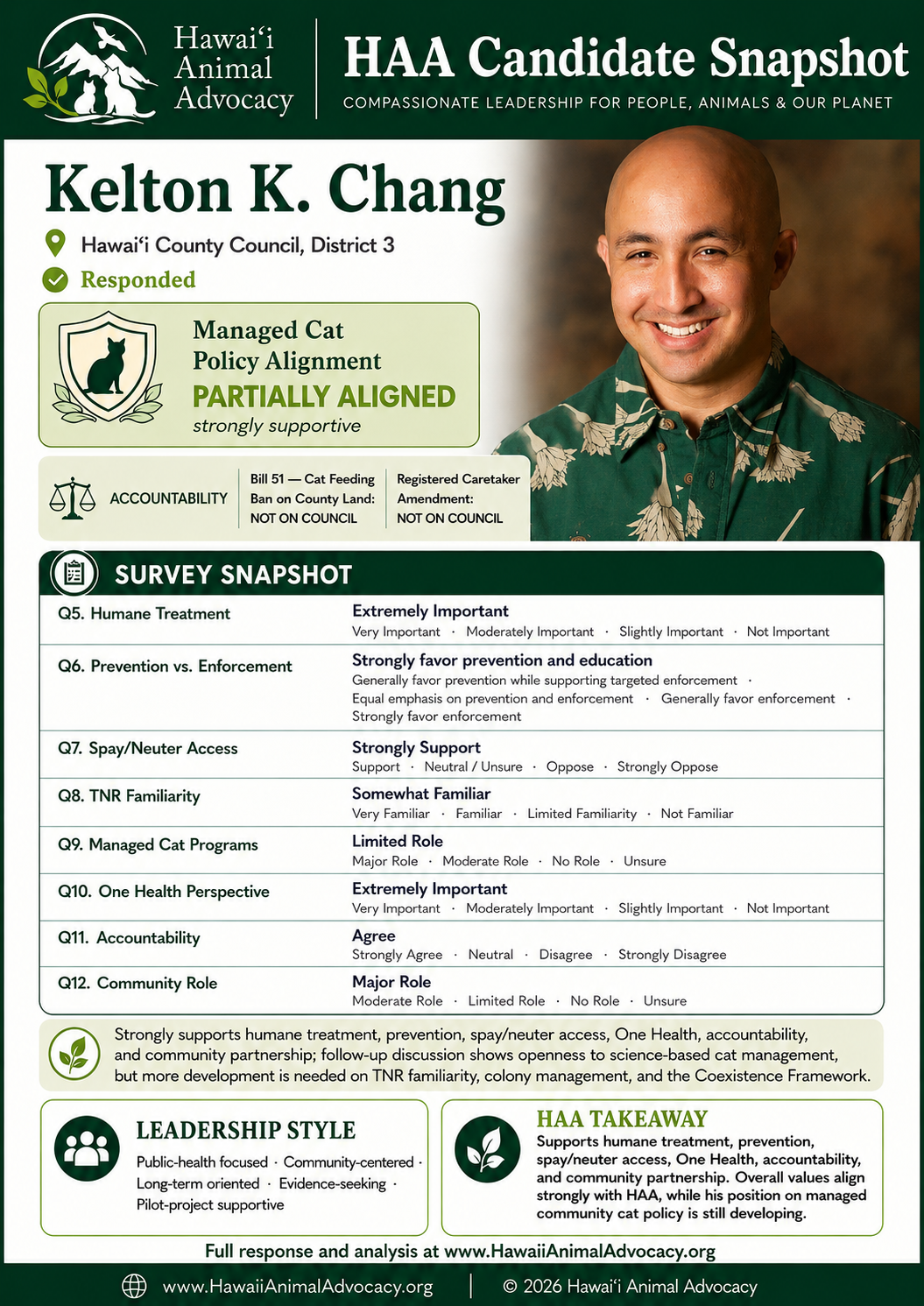
1. HAA Candidate Snapshot
2. HAA Assessment
Managed Cat Policy Alignment: Partially Aligned — Strongly Supportive, with Managed Cat Policy Still Developing
Kelton K. Chang’s survey response demonstrates strong support for humane, prevention-oriented, community-based public policy.
He rated humane treatment and the One Health perspective as Extremely Important, strongly supports expanded access to low-cost or free spay/neuter services, strongly favors prevention and education, agrees that government-funded programs should demonstrate measurable outcomes and public accountability, and believes community organizations and volunteers should play a Major Role in helping address county challenges.
His leadership responses also reflect several qualities that align strongly with HAA’s approach. Chang selected public health and safety, legal considerations, community partnerships, transparency, long-term thinking, and community input as important elements of public policy. He also supports meeting affected residents, visiting impacted locations, seeking additional information and evidence, and starting with small pilot projects that can be evaluated before broader implementation.
These responses indicate a thoughtful, community-centered and evidence-seeking approach to public service.
Managed Community Cat Policy
Chang identified himself as Somewhat Familiar with Trap-Neuter-Return and selected a Limited Role for managed community cat programs in Hawaiʻi County.
Those responses do not indicate opposition to humane community cat management. However, they also do not establish clear support for TNR, returning sterilized cats to appropriately located colonies, or using professional colony management as a significant component of county cat population policy.
This distinction is important because HAA’s Coexistence Framework does not propose maintaining unmanaged cat populations. It calls for different strategies in different locations:
- Responsible ownership, sterilization and abandonment prevention for pet cats
- High-intensity TNR, adoption and professional management for appropriate community-cat locations
- Humane removal of cats from sensitive wildlife conservation areas
Chang’s survey supports many of the prevention, accountability and community-partnership principles underlying this approach, but it assigns managed community cat programs only a limited role.
Follow-Up Meeting with HAA
Following the survey, Chang spent approximately two hours meeting with HAA to discuss cat population management, TNR, professional colony management, wildlife protection and the Coexistence Framework.
HAA found him to be reasonable, friendly, engaged and willing to think critically about complex policy questions. He listened carefully to the explanation of how professionally managed colonies differ from unmanaged cat populations and how the Coexistence Framework is designed to protect both animals and sensitive wildlife areas.
The time he devoted to the discussion and his willingness to consider additional evidence are meaningful positive indicators.
The meeting suggested that Chang is open to humane, science-based cat management when programs are accountable, properly designed and supported by evidence. However, he did not provide an explicit commitment to TNR, return-to-colony, or professional colony management. He also emphasized that he could not guarantee a future policy position before reviewing the evidence and circumstances of a specific proposal.
HAA views that caution as consistent with a case-by-case decision-making approach, but it means his alignment with the central managed-cat component of the Coexistence Framework remains less certain than his alignment on broader humane-policy principles.
HAA Alignment
Humane Animal Policy
Strongly Aligned
Chang strongly supports humane treatment, prevention and education, expanded spay/neuter access, and a major community role.
One Health
Strongly Aligned
He rated the interconnection of human, animal and environmental health as extremely important.
Evidence and Accountability
Aligned
He supports additional information and evidence, pilot projects, long-term outcomes and public accountability. He selected Agree, rather than Strongly Agree, regarding measurable outcomes and accountability, but his broader responses support evidence-informed evaluation.
Managed Community Cat Policy
Partially Aligned / Still Developing
He is open to learning about humane and science-based approaches but has not yet clearly endorsed TNR, return-to-colony, or professional colony management as a major county strategy.
Coexistence Framework
Promising but not fully confirmed
His broader values align closely with the framework’s goals, particularly prevention, One Health, community involvement, wildlife protection and evidence-based policy. Clear support for the Community Cat Zone strategy has not yet been established.
HAA Takeaway
Kelton K. Chang demonstrates strong support for humane treatment, prevention and education, expanded spay/neuter access, One Health, community partnership, long-term thinking and evidence-informed policymaking.
His willingness to spend significant time discussing the issues and learning about the HAA Coexistence Framework is a meaningful sign of constructive engagement.
However, his survey selected only a limited role for managed community cat programs, and he has not yet made a clear commitment to TNR, return-to-colony or professional colony management.
Overall assessment: Partially Aligned — Strongly supportive of HAA’s broader humane-policy principles, with his position on managed community cat policy still developing.
.