

Hawaiʻi Animal Advocacy (HAA) is a Hawaiʻi-based nonprofit organization advancing humane, evidence-based solutions for community cats, native wildlife protection, public health, and responsible animal management.
Our work focuses on prevention, accountability, coexistence, and practical policy solutions that reduce suffering while protecting Hawaiʻi’s unique ecosystems and communities.
Humane policy is effective policy.
.
HAA works at the intersection of: Animal Welfare, Wildlife Conservation, Public Health, Responsible Pet Ownership, Humane Population Management, Community Education, and Evidence-Based Public Policy.
We believe long-term solutions must address the root causes of animal overpopulation and wildlife conflict — not simply react after problems escalate.
Candidate Pages
2026 Primary Results - Path To Majority Support
For Humane Cat Policy and Hawaiʻi’s Cat-Connected Electorate
helping voters and candidates understand humane, evidence-based cat policy.
The final results of Hawaiʻi County’s 2026 primary election tell a more complete story than simply counting how many supportive candidates advanced.
Across the nine County Council seats, five incumbents sought reelection. All five won. Four of those incumbents — Heather Kimball, Dennis “Fresh” Onishi, Holeka Inaba and James Hustace — had voted yes on the final passage of Bill 51, the county-land animal-feeding prohibition. Jenn Kagiwada had voted no.
That meant much of the opportunity for change was concentrated in the four districts without an incumbent.
What the Results Mean
Looking across all nine Council districts, the primary produced a mixed but significant result.
All five incumbents were reelected. Four of those five had voted for Bill 51, while one — Jenn Kagiwada — had voted against it.
At the same time, one of those four Bill 51 supporters, Heather Kimball, now has a clearly documented position in favor of humane, managed cat policy through the HAA Election Center.
Among the four open seats:
That creates a clear arithmetic pathway toward five of the nine total Council members with documented support for humane, science-based animal management, depending on the outcome in District 4.
The significance goes beyond a simple vote count.

.
Voter Education Notice: HAA’s Election Center, Candidate Summary, candidate snapshots, and candidate pages are provided for issue-based voter education. They are based on candidate survey responses, follow-up clarification when provided, and HAA’s assessment of alignment with humane, accountable managed cat policy. They are not formal single-candidate endorsements and should not be represented as such.
.
The evidence reviewed in this brief supports two important conservation findings:
First, reliable, nutritionally adequate feeding can reduce bird predation by reducing cats’ hunting activity and their reliance on wild prey.
Together, these findings show that managing community cats can directly reduce important pathways of bird predation while simultaneously controlling reproduction and reducing the cat population over time.
Snapshot Brief - click here to read


PUBLIC HEARING AUG. 13 | WRITTEN TESTIMONY DUE AUG. 26
DLNR is proposing major wildlife-rule changes that go far beyond community cats.
NEW: Why This Is Bigger Than Cats [read now]
Read the HAA Truth Sheet explaining the potential expansion of wildlife law and why it may affect ordinary Hawaiʻi residents.

.
Detailed guidance on how the proposal could affect community cats, TNR, feeding, trapping, veterinary care and humane population management — plus sample testimony and sources.

NEW RELEASES:
 |
 |
 |
.
We are releasing Version 2.1 of the Coexistence Framework — an adaptive ecological cat population management system designed to reduce unmanaged cat populations while protecting Hawaiʻi’s wildlife, public health, and communities.
This updated version is built on two important foundations:
Conservation Science Pillars [see Conservation Science Compliance Standard]
Adaptive management, landscape ecology, systems ecology, risk-based prioritization, outcome-based conservation, and measurable accountability.
One Health Guidelines [see One Health Alignment Standard]
Recognizing that human health, animal health, wildlife health, and environmental health are connected — and that good policy must consider all of them together.
The framework does not say cats should be everywhere. It does not reject conservation science. It does not support unmanaged colonies.
Instead, it creates a practical three-zone model:
The goal is simple:
Prevent new cats. Stabilize and reduce existing outdoor cat populations. Protect sensitive wildlife habitat. Monitor outcomes. Adjust based on evidence.
Hawaiʻi needs a better path than unmanaged cats, unmanaged feeding, feeding bans without population control, or policies that measure activity instead of outcomes.
The Coexistence Framework is HAA’s proposal for a more accountable path forward — one grounded in science, humane treatment, conservation protection, public health, and Aloha ʻĀina.
.
.
Why Transparent Scientific Wildlife Mortality Investigations Matter for Hawaiʻi Conservation Policy
The reported mortality of approximately 167–200+ ʻuaʻu kani, or Wedge-tailed Shearwaters, on Kauaʻi is a serious wildlife event deserving careful scientific investigation and public attention. Cats are recognized predators of wildlife and can impact vulnerable island species, especially in sensitive nesting areas. However, established conservation science also emphasizes that wildlife mortality events should be investigated using transparent, evidence-based methods before definitive conclusions are used to shape public opinion, public policy, or animal management decisions.
This principle is not unique to cat management. It reflects broader standards already recognized throughout conservation biology, wildlife forensics, adaptive management, and evidence-based conservation science.
Truth Sheet - click here to read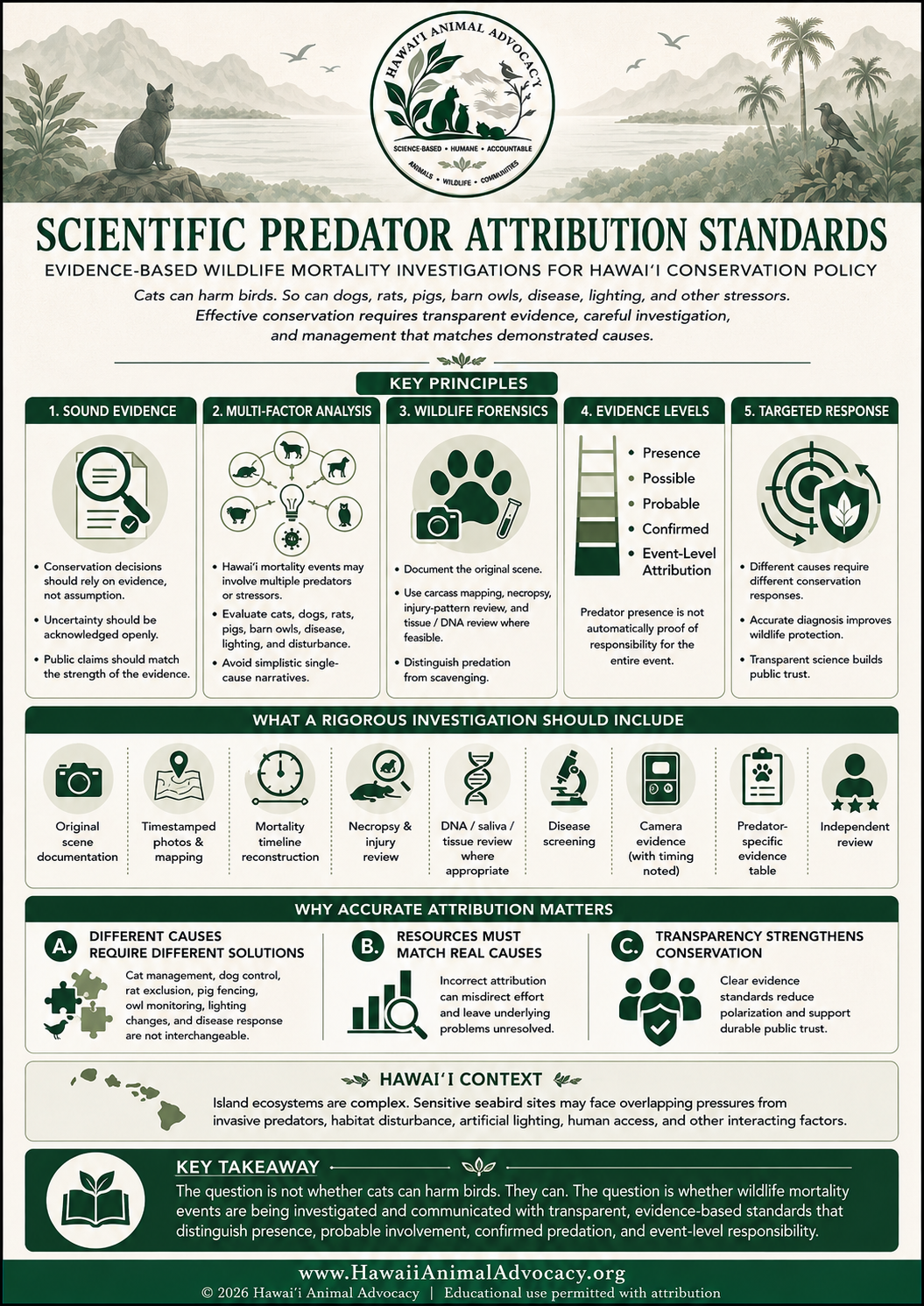

..
Humane Cat Population Management
Promoting targeted spay/neuter, managed colony systems, adoption programs, and prevention-focused strategies that reduce suffering and stabilize populations over time.
Wildlife & Conservation
Supporting science-based conservation approaches that prioritize ecological protection while avoiding simplistic or counterproductive narratives.
Public Policy & Legislative Advocacy
Developing policy briefs, legislative testimony, scientific truth sheets, and educational materials that support humane and effective public policy.
Public Health & Community Responsibility
Encouraging responsible pet ownership, abandonment prevention, vaccination, sanitation, and community accountability.
Education & Scientific Communication
Providing accessible, evidence-based information to residents, policymakers, media, and community organizations throughout Hawaiʻi.
.
Unmanaged reproduction, abandonment, lack of sterilization access, and fragmented policy responses continue to drive animal suffering and wildlife conflict across Hawaiʻi.
HAA believes prevention-based strategies are the most effective path forward.
This includes:
Early intervention
Accessible spay/neuter programs
Community partnerships
Responsible ownership
Transparent management systems
Data-driven policy evaluation
HAA supports rigorous, evidence-based standards for evaluating:
Wildlife mortality events
Predator attribution
Population management outcomes
Public health concerns
Conservation policy impacts
Good policy requires good science, transparency, and accountability from all stakeholders.
.
HAA actively monitors and engages with Hawaiʻi legislation and county-level policy involving:
Animal welfare
Community cat management
Wildlife conservation
Public health
Shelter systems
Humane enforcement practices
We provide:
Policy analysis
Action alerts
Legislative testimony
Executive summaries
Scientific briefs
Public education materials
.
HAA supports Hawaiʻi residents with educational resources related to:
Responsible pet ownership
Community cat management
Property owner guidance
Humane deterrence
Spay/neuter access
Wildlife coexistence
Abandonment prevention
.
HAA is a grassroots Hawaiʻi nonprofit supported by residents who believe humane, science-based solutions are possible.
Your support helps fund:
Educational materials
Scientific briefs
Legislative advocacy
Community outreach
Public awareness campaigns
Humane management initiatives
Together, we can build practical solutions that protect both animals and Hawaiʻi’s ecosystems.
.
You can support HAA by:
Fixing and vaccinating pets
Supporting humane legislation
Volunteering
Sharing educational materials
Promoting responsible ownership
Supporting targeted spay/neuter programs
Donating to HAA’s work
.
Advancing humane, evidence-based solutions for Hawaiʻi’s animals, wildlife, and communities.
PLEASE CLICK HERE TO DONATE NOW -
Help us protect the Cats in Hawai'i